
30 October 2025
Ivana Kostovska & Paul Hammoud
The CresCine project will soon publish the report, titled ‘Small Film Markets’ Policy Toolkits.' The forthcoming report offers a comparative analysis of national policy frameworks that support the film industry, focusing on how these frameworks enhance or impede the competitiveness of small markets in the global competitive landscape. The report examines seven small European ecosystems - Croatia, Estonia, Denmark, Flanders in Belgium, Ireland, Lithuania and Portugal. Furthermore, these small ecosystems are compared with larger European markets (Spain, France, and the UK); smaller European markets (Norway and Czechia), and non‐European markets (South Korea and Canada).
To explore the policy toolkits of the seven CresCine ecosystems (Estonia, Croatia, Denmark, Flanders in Belgium, Ireland, Lithuania, and Portugal), the report adopts a qualitative approach that combines policy‐measure mapping with expert interviews. It aims to provide in‐depth insights into film support policies, national strategies, and how these measures either bolster or impede the competitiveness of small film ecosystems. The report explores a broader range of policy questions and offers extensive analysis of film policy support measures. This policy brief is dedicated solely to discussing insights on strategic pillars of public support mechanisms and recent changes in film support policies.
Highlights
| Production incentive schemes as levers for competitiveness: The jurisdictions covered in the report fine-tune these policy instruments by modulating base rates, eligibility threshold and conditional criteria to attract inward productions while nurturing local industry capacity. The benchmark of competitiveness is not only the high percentage on offer, but the extent to which an incentive channels expenditure into skills development, infrastructure use, long-term sector resilience and stimulates broader economic activity. When policy design is oriented only toward maximising expenditure, cultural objectives related to the development of indigenous talent and the financing of domestic culturally relevant films may be insufficiently prioritised. Addressing this tension requires a deliberate configuration of incentive structures to ensure that short-term economic gains do not undermine long-term sustainability of the film industry and local production. |
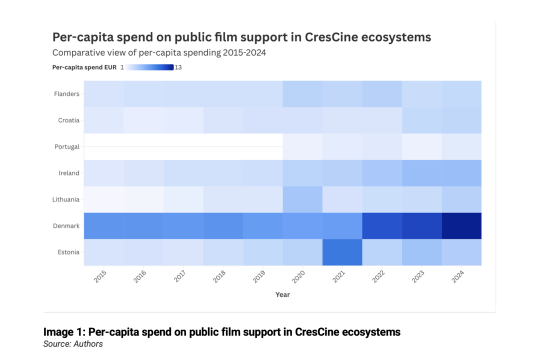
| Public funding levels are crucial for implementing policy measures that foster competitiveness: Among the CresCine screen agencies, the Danish Film Institute commits the largest volume of resources to film (levels of film support). Denmark’s policy mix features generous per-capita subsidies, including substantial regional funding. Interviewees in the screen agencies with lower budgets from CresCine territories outlined that scarce resources constrain policy design: when funding barely covers core subsidies, it is difficult to build a more varied toolkit to support competitiveness. |
| Screen agencies to institutionalise periodic analysis of competitiveness: The analysis in this report shows that there are different understandings of how policy can support competitiveness and what competitiveness is. It is important for the screen agencies to mandate and benchmark progress of competitiveness. EFAD could serve as a platform to create a shared knowledge base of transferable practices, facilitating evidence-based policy diffusion. EFAD can serve as the coordinating body, hosting a knowledge repository of transferable practices and convening triennial peer reviews. Insights from the co-design workshop, pilot schemes in three small markets, and EFAD exchanges should demonstrate the efficacy of this approach. |
| Ensure alignment between policy instruments in the policy toolkit: To enhance the overall efficacy of policy toolkits, all public support schemes must be integrated so that each element reinforces the others rather than operating independently. Annual reports should trace the flow of public support across instruments, assessing not only headline spend but also how the objectives under the strategic pillars have been met. All support measures — production incentives, selective grants and regional funding (where available)—should be designed and assessed a shared set of high-level objectives. |
The research project CresCine started in 2023 and will run until 2026. It is funded by the European Union’s Horizon Europe research programme (Grant number: 101094988). The consortium consists of 16 research and industry organizations in 10 countries. The research project’s leader Manuel Damasio from Lusofona University in Lisbon highlights that “the economic and cultural importance of local film industries in small countries and regions is why the CresCine project has been investigating what makes small film-producing European countries and regions special and how they cope with the competition from large countries like the USA.” More information on the participating organisations and the project’s output can be found online at www.crescine.eu.
1. What is covered in the latest CresCine report?
The CresCine research project aims to enhance the competitiveness and cultural diversity of the European film industry. It studies seven small film producing countries and regions: Ireland, Denmark, Estonia, Lithuania, Portugal, Croatia, and Flanders in Belgium. The choice of markets covered in the project reflects not only different geographical positions, but also countries and regions with very different film production cultures.
The report traces recent policy changes and analyses how film-support schemes and other measures in the CresCine ecosystems-and in comparable territories-have been revised. It also delves into into incentive schemes and compares the levels of support provided by different screen agencies. Also, the report analyses the strategic roadmaps, relying on strategic policy documents and presents case summaries of the seven small ecosystems. Additionally, the report summarises the funding criteria under the screen agencies, compares the levels of film support and analyses key strategic pillars as building blocks of the policy toolkits identified through our analysis of support schemes and underlying criteria for funding.
Ivana Kostovska, senior researcher at imec-SMIT-VUB who has been leading the latest report outlines: “As film industries in small markets are typically more dependent on public support and screen agencies often operate with limited budgets, it is especially important to identify support schemes and underlying selection criteria that are effective and transferable to other small-market contexts. In this report, we outline objective-led strategic pillars as the building blocks of the policy toolkits. The idea is that only a coherent policy mix ensures policy objectives are met and competitiveness improved.”
1.1 Recent changes in film support policies
Over the past several years, film support schemes within the CresCine ecosystems-and in other territories-have been revised. Several jurisdictions have amended their tax‐incentives to align with evolving industry trends and strengthen their competitive positioning by offering more generous programs. Regarding tax incentive reforms, Denmark’s planned measures may represent the most substantial overhaul. As one of only two European countries (alongside Luxembourg) without a production incentive, Denmark decided to introduce a new production rebate to attract international film and television shoots. Under the proposed rebate scheme, starting in 2026, film and series productions will be able to claim reimbursements of approximately 25% of their costs. The government has announced an annual allocation of €17 million (DKK 125 million) to support the rebate program.
Another significant policy update to film-support systems is the introduction of investment obligations for global streaming services, made possible by the EU’s 2018 Audiovisual Media Services Directive. Of the seven CresCine ecosystems, five have either enacted investment obligations or included them in draft legislation. The cultural levy in Denmark came into effect on the 1st of January 2025 and requires on-demand streaming service providers to pay a basic rate of 2% of their Danish revenues. Streaming services that invest less than 5% of their Danish turnover in domestic content must pay an extra 3% levy, bringing their total contribution to 5%. Flanders updated its investment-obligations for Netflix and other streaming services, both raising the contribution rate and extending the rules to video-sharing platforms. Beginning the 1st of January 2025, any service with local turnover over €30 million must allocate 4% of that revenue to local audiovisual production. Under the new regime, these platforms may channel their contributions into feature films as well as television works. A levy was legislated in Ireland in 2022, yet it remains unimplemented and uncertain.
Outside the seven CresCine ecosystems, Czechia has implemented a new investment obligation for streaming services. Every service operating in the country must now support Czech audiovisual production through a single charge that merges a levy and a direct-investment requirement: 1% of turnover is paid as a fixed levy, while a further 2.5% can be split-at the streamer’s discretion-between an additional levy and direct investment in local content. In the United Kingdom, policymakers are debating whether to impose a mandatory investment obligation on streaming platforms. In April 2025 the House of Commons Culture, Media & Sport Committee formally urged the Government to introduce a 5 % levy on all SVoD services’ UK turnover and recommended that the requirement be written into law if the industry fails to adopt it voluntarily within twelve months. In 2024 the Canadian Radio-television and Telecommunications Commission (CRTC) set a base contribution rate of 5% for online broadcasters. The Online Streaming Act, adopted in 2023, establishes a legal framework for regulating digital platforms and obliges them to help finance the creation, production, and distribution of Canadian content.
Aside from changes to tax incentive schemes and investment obligations, the jurisdictions analysed have also refined development and production support measures and implemented carbon footprint reduction policies.
Beyond the CresCine ecosystems, our comparative analysis shows that other jurisdictions have also updated production incentives. For example, In Spain, through the Spanish Society for Technological Transformation (SETT), the Government of Spain is mobilizing €1.7 million destined to support the consolidation of the sector, promoting the leadership of Spain in audiovisual and strengthening the competitiveness of Spanish companies in the global market. The funds, under loans or repayable investments are new financial instruments offered by the Spain Audiovisual Hub with the objective of encouraging private investment and improving access to funding for projects related to film, television, content generation, digital culture, as well as the development of multimedia and interactive content, such as video games and visual effects, among others. The Spain Audiovisual Hub plan (2021-25) aims to power up Spanish film and TV production and encourage big foreign players to shoot and set up production centers in Spain.
2. Strategic Pillars
The report presents eight key strategic pillars as building blocks of the policy toolkits identified through the analysis of support schemes and underlying criteria for funding in the small ecosystems: culture, international sales and festival competitiveness, diversity, inclusion and gender balance, environmental sustainability, innovation, audience potential and enhancing co-productions.
1. Enhancing artistic and cultural potential
Across the CresCine ecosystems, enhancing cultural potential act as a primary objective: projects supported by screen agencies must demonstrate a clear connection to national language, heritage, themes, or creative talent before any economic or market factors are considered. For example, applications by Flanders Audiovisual Fund (VAF) are evaluated based on: 1) artistic quality: originality, narrative strength, and creative vision; cultural significance (contribution to Flemish culture, language, and identity); feasibility (realistic planning, budgeting, and potential for successful completion); 4) audience engagement (potential to reach and resonate with audiences, both domestically and internationally).
2. Enhancing international sales and festival reach
Outward-looking emphasis on international sale and festival reach ensures that public support advances projects capable of securing global visibility and revenue, reinforcing both cultural export and sector competitiveness.
Screen Ireland's funding criteria highlight international co-production potential, festival/market viability, and sales agent/distribution plans. The agency supports Irish producers partnering with international counterparts and emphasizes the importance of international reach and festival competitiveness. The importance of international competitiveness is sometimes outlined as objective in the funding criteria. For example, as a result of granting the distribution support, the Estonian Film Institute expects that the Estonian cinematography shall be viable, original and internationally successful, taking the audience into account, and representing the past and present in a diverse and engaging manner. As part of the evaluation criteria, the Estonian Film Institute considers questions such as what is the film’s theatrical potential and what is the potential of film festivals.
International sales often appear as a core objective within festival support schemes. For example, the Danish Film Institute provides support for international promotion of films that have been selected for festival distribution in one of the film festivals prioritised by the Danish Film Institute. The purpose of the support scheme is to spread awareness of and promote the sales of Danish documentaries, feature films and other visual formats abroad. In Flanders, VAF provides international promotional support with the objective of increasing and optimising the visibility of Flemish creations and Flemish talent. The support can be used when Flemish creation is selected at a foreign festival, following a nomination for a film award and within the framework of special film programmes. VAF also provides a premium for developing promotional materials during the production phase.
3. Supporting diversity, inclusion and gender balance
Across the CresCine ecosystems, diversity and inclusion more often are used as eligibility requirements: screen agencies systematically weave gender balance, multicultural representation, and equitable workforce practices into their support criteria, often requiring applicants to document concrete measures and meet explicit targets. By embedding these standards alongside other funding criteria, the schemes aim to ensure that public resources broaden participation and on-screen representation. In Ireland, Screen Ireland has developed a funding scheme - Animation Pathways Diversity, Equity and Inclusion Fund specifically for the Animation sector to create more inclusive opportunities on productions for those from diverse and under-represented communities and those where access to the industry would historically be limited.
4. Supporting environmental sustainability
CresCine ecosystems have also implemented dedicated green film initiatives, ranging from criteria for receiving public funding and uplifts to sustainability coordinators. In Estonia, the Tartu Film Fund provides up to 5% of evaluation score for funding when sustainable and environmentally friendly production principles are implemented. From late 2024 onward, the Danish Film Institute requires every film production to submit a sustainability plan grounded in the Green Film handbook, with the goal of cutting the industry’s CO₂ emissions through greener production practices. In Lithuania, sustainability measures have recently become part of the application form and scoring under the funding schemes of the Lithuanian Film Centre.
5. Supporting innovation
Only some CresCine ecosystems have dedicated innovation-oriented funding schemes, besides the traditional development, production and distribution streams. In Ireland, Screen Ireland has established the Animation innovation and immersive development fund-a dedicated, competitive programme (launched in 2021 and renewed for 2024/25)-to seed high-concept prototypes that explore new storytelling formats across animation, VR, AR and app development. Projects are assessed on the quality and level of innovation in their use of emerging technologies (immersive storytelling, interactivity, XR techniques), the creative coherence between narrative and format, and the market potential of the concept.
6. Supporting audience potential
In Denmark, the film projects supported under the Market Scheme are expected to sell more than an average Danish feature film in cinema tickets in Danish cinemas. The applications are assessed regarding narrative, audience, distribution, marketing and the film's overall financial sustainability. For the films supported under the Consultant Scheme, there are no special requirements for genre or audience appeal. The purpose of this scheme is to support the art of storytelling. Also, DFI has a support scheme for dissemination of films for children and young people. The purpose of the support scheme is to promote children and young people's opportunities to experience, understand and create moving images themselves, as well as to contribute to the development and anchoring of educational offerings in the film and media field in day care facilities, schools and youth education. VAF in Flanders also offers support for development and production of fiction films for children and youth.
7. Enhancing collaborations through co-productions
Each CresCine ecosystem operates minority co-production schemes under its respective screen agency. Typically, co-productions supported by the screen agencies must be approved as official co-productions under a bilateral treaty or the European Convention on Cinematographic Co-production. In some cases, like in the case of Croatia where the Croatian Audiovisual Centre agrees to waive this requirement, but films must still be structured as bona fide co-productions in which ownership, rights and revenues are shared among the co-producers.
8. Supporting talent development
Across the CresCine ecosystems, screen-agency talent programmes include development, production and promotion grants, mentorship and structured training within their core funding support, aiming to create policy levers for supporting the sector's competitiveness and skills development.
The Danish Film Institute’s New Danish Screen operates as a low-budget incubator for professional-level talent, financing development, production and promotion of fiction, documentary and hybrid projects. The VAF’s talent-development support, marketed since 2024 under the banner “VAF Next Generation”, pairs support with structured coaching to accelerate the transition from film-school graduation to a first professional credit. The key policy instruments are Wildcards (production grants) and Booster Cards (mentoring packages). Together they form a single, competitive scheme embedded in the VAF/Film Fund budget., VAF positions the Wildcard/Booster Card scheme as a pipeline that refreshes the Flemish creative pool, aligns with wider VAF goals on diversity and sustainability, and feeds higher-budget funding lines with early-career talent. Within its 2024-28 strategic plan, Portugal’s ICA sets forth annual funding for new talent and related first-work strands, reinforcing this with writers’ contests and mentoring partnerships.
3. What else can you find in the report?
Strategic policy blueprints Across the CresCine ecosystems and in the larger and non-European reference territories, cultural policy is translated into multi-year statutes, film agreements, management contracts, and strategic plans. These documents in some cases set measurable targets for market share, festival visibility, regional engagement, and greening, while also outlining specific policy priorities. Certain strategies show preference for setting broader goals such as training, inclusion, sustainability, or administrative efficiency, leaving performance to be monitored through qualitative benchmarks. |
Analysis of production incentives in Crescine ecosystems Each CresCine ecosystem has structured its incentive scheme to allow access for both national and foreign productions. Typically, foreign producers collaborate with a local company-either as a co-producer or service provider which formally submits the application. The resulting financial support benefits the foreign producer through reduced local production costs or co-production financing. Some CresCine ecosystems, such as Flanders and Portugal offer dual-layer models. Flanders offers federal tax shelter and regional repayable support through Screen Flanders. Portugal offers a cash rebate established in 2018 and cash refund (PIC Portugal) as a relatively new incentive introduced in 2024. Some incentives are designed around investor engagement. In Lithuania, this takes the form of a private-investment scheme that mandates producers to connect with private investors. In Flanders, the Belgian tax shelter enables certified Belgian (co-)producers to draw on Belgian investors’ taxable profits, directing these funds into eligible audiovisual works. |
Funding criteria for film support under the screen agencies The analysis of the funding criteria under the support schemes of the screen agencies in the CresCine ecosystems indicates attempts to balance cultural and economic strategic imperatives. Funding criteria often bring together cultural and economic objectives, reflecting the need of screen agencies in small markets to stretch modest budgets across multiple policy objectives. Looking into the funding criteria matters because it shows how public funding has been steered toward film projects that can strengthen a territory’s narrative identity while building commercially resilient companies, developing audiences, attracting private financing, and developing talent - and ultimately, enhancing competitiveness. |
For further information on the forthcoming report ‘‘Small Film Markets’ Policy Toolkits,' subscribe to the CresCine newsletter or check CresCine’s website. The work on the report was led by Ivana Kostovska, senior researcher at imec-SMIT-VUB with contributions from Paul Hammoud, junior researcher at imec-SMIT-VUB
Ivana Kostovska is a senior researcher in film and TV economics at imec-SMIT, VUB. Her work is focused on understanding the impact of the ongoing changes in the European film and television industries driven by the rise of global streamers and platforms. Her research explores shifts in policy measures at the EU and national levels and their impact on the film and television industries, focusing on investment obligations for global streamers and rules governing contractual relationships between AV producers and financiers, including IP rights. She conducts contract research for various stakeholders, including the European Commission, and is currently part of the EU Horizon Europe project CresCine, which focuses on enhancing the international competitiveness of the European film industry.
Paul Hammoud is a junior researcher at imec-SMIT, VUB. His primary research areas and professional focus revolve around understanding and analysing the dynamics of film distribution and policy within a global and European context. With a keen interest in EU policies and the audiovisual industry, he is dedicated to fostering a more vibrant and resilient European film landscape. Paul is currently working on the project CresCine, in collaboration with a large consortium of professionals from the film industry and researchers from other European universities.
CresCine on Social Media
https://www.linkedin.com/company/crescine/
https://www.facebook.com/crescine/
https://www.instagram.com/crescine_eu

