18 December 2025
Louise Hallström, Arno Verhofstadt, Iris Jennes & Wendy Van den Broeck
Innovation projects often deliver promising technological solutions, developed and tested in specific use case domains. Exploitation plans typically focus on capacity building within the same narrow use case contexts, limiting their long-term impact and return on investment. In this policy brief, we argue that transferability must actively be addressed during the project lifecycle, by actively exploring how technologies or products can be adopted beyond their original scope. Embedding cross-sector collaboration, stakeholder involvement, and co-creation directly linked to project workflows can increase the relevance, sustainability, and long-term impact of innovations. Drawing on insights from a transferability workshop methodology within the Horizon Europe TRANSMIXR project, this brief shows how human-centered participatory methods can strategically be used to support transferability.
Highlights
| Design for transferability, do not assume it: Transferability is not an automatic outcome when a technology or product has been developed. It requires deliberate choices throughout the project's lifecycle, including decisions about which technologies are demonstrated, which stakeholders are involved, and how learning and reflection are structured. Embedding transferability exploration within workflows in innovation projects increases the chances of long-term impact and adoption of technologies and products beyond their original context. |
| Cross-sector engagement is key for meaningful transferability: Engaging stakeholders from different sectors is essential to assess how technologies and products can fit within their contexts. Participatory and co-creation approaches help uncover sector-specific needs, workflows, and constraints that are often difficult to identify from within the project’s original domain. A human-centered, cross-sector perspective strengthens the relevance of technologies and creates the conditions for successful adoption in new contexts. |
| Participatory methods enable actionable outcomes: Structured participatory methods, such as guided discussions, SWOT analyses, and future scenario building, support the translation of technological potential into actionable insights for the intended sector. These methods help reveal adaptation needs and generate inspirational creative concepts that guide future innovation and collaboration. |
1. Why transferability?
Transferability is about seeing how a technology or product can be used in new/other domains or contexts other than where it was first created. Basically, it asks whether the idea can work well in other settings too. The goal is to find out if the benefits of the technology or product can extend beyond its original purpose and be meaningful and useful elsewhere.
Explicit attention to transferability helps prevent technologies from remaining confined to narrow or single-use contexts. It also helps to get more value out of the invested time, efforts, and money in developing these technologies. Innovation projects typically last two to three years and focus on specific use cases and demonstrators for the developed technologies. While exploitation plans often outline intended pathways after project completion, it is not always clear what will happen in practice once the project ends. By actively looking at how the technologies could potentially be used within other sectors and contexts, the chances of long-term adoption and lasting impact are higher.
Effective transferability assessment requires the active involvement of stakeholders from potential transfer sectors or contexts. Cross-sector engagement places people and their real-world practices at the center of technological development. By working directly with actors from different domains, project teams gain insight into how technologies would need to align with existing workflows, values, constraints, and organizational cultures. This helps move beyond assumptions and enables more realistic assessments of where and how an innovation could be adopted.
Cross-sectoral collaboration plays a dual role, first by ensuring that technologies and products are shaped around real human needs through participatory design. Secondly, this also creates a strong foundation for their transferability to other sectors. As diverse stakeholders are involved early on and throughout development processes, technologies and products are shaped by their diverse needs, experiences, and perspectives. This makes them more usable, relevant, and inclusive from the start, not only within their original context, but also across sectors.
2. Transferability in practice
How do we then address transferability in practice? There are a few steps to be taken, first we need to decide which technologies or products are suitable for transferability exploration and how these should be demonstrated in a way that is understandable and relevant beyond the original use case. Secondly, we need to reflect on what stakeholders and from which sectors should be involved. Finally, we need to decide how targeted co-creation exercises can be designed and organized.
To illustrate this approach, we use an example from the TRANSMIXR project, where we conducted several transferability workshops with representatives from different sectors (agriculture, architecture, entertainment, gaming, medical sector, SMART education, and sports). We will use the example of a co-creation workshop with educators to explore how the project technologies – the Newsroom Toolbox, XR Stories, the Virtual Control Room, the Virtual Studio Environment, CAI, the Space Archivists, and the Curator Studio – could fit within an education context.
2.1. Step 1: Demonstrating technologies
The first step in addressing transferability is to decide which technology or product to demonstrate and how it can best be presented to external stakeholders. This decision shapes how stakeholders will understand the technology, which will influence the quality of the discussion following the demonstration. An effective way to demonstrate technologies or products is to combine formats, such as videos, walkthroughs, and live demonstrations, as this allows stakeholders to quickly grasp the concept idea while being able to interact hands-on with selected items. Two considerations that should guide this decision are that the demonstration should not overwhelm participants and that it should be practically feasible to showcase the technology or product.
For example, in the TRANSMIXR project, we developed a so-called ‘Demonstration Box’ to showcase all technologies developed within the project. Originally, it was intended to take the form of a physical kit bringing together all project technologies for live demonstrations. However, this was not feasible as it was quite complex to fit all technologies and their different setups into a single transportable set up. Instead, project partners produced videos to showcase the technologies and use cases.
To give stakeholders the possibility to interact with the technologies hands-on, we selected a few tools or technologies to be demonstrated live. In the educator workshop we did a live demonstration of the XR stories experience Planica XR, which allowed participants to engage directly with an XR experience to better imagine how a similar experience could fit in their own context. The following technologies and use cases were demonstrated in the Demonstration Box video:
| News Media | This use case explores how journalists can use XR and AI-powered tools to create more engaging and immersive news content. In the TRANSMIXR Newsroom Toolbox, AI tools (such as the Dashboard tool, Storypact Text Editor tool, and the CERTH Video Summarization tool) support the full news workflow: from discovering trends and breaking stories, to writing and adapting articles, and creating short video summaries. Alongside this, XR stories, exemplified by Planica XR, brings audiences closer to major news events like the Slovenian ski jumping world championships. The video showed how the XR Stories experience was created. From gathering information about Planica, the world championship, and climate change, using the Newsroom Toolbox, to developing the VR experience, to then getting a look at what you can see and do in the experience. For example, you can soar over the area in a hot-air balloon, interact with 3D objects, and interview a climate expert. |
| Control Room of the Future | This use case explores how XR and AI can be used in news broadcasting for more interactive and immersive ways of consuming news content. Instead of relying on traditional studio setups, news teams can – through the Virtual Control Room and Virtual Studio Environment – collaborate remotely, personalize programmes, and create immersive experiences for diverse audiences across platforms. The video showed how news spectators can actively participate through the Virtual Studio Environment, a website platform which allows audiences to join a news broadcast through VR headsets or without. They can here participate in discussions through a live chat. Then the Virtual Control Room is shown, wherein it is explained how the director can set up the news broadcast but also how they can control the ongoing show while being fully immersed in VR. |
| Enriching Performing Arts Experiences | This use case explores how Mixed Reality (MR) can – through immersive storytelling and interactive environments – create personal and emotionally engaging performance experiences. Here, a main experience was developed: Cadence of Altered Illusions (CAI) which invites participants to experience the life story of the main character as they move through different scenes that blend physical and digital space. This use case integrates motion capture, volumetric video, performance, theatre, and AI to create more engaging and immersive storytelling experiences. The video showed how motion capturing can be used for performing arts to capture movement and translating it into a volumetric avatar. A sneak peek into CAI was also included, where from a first-person perspective you see how the real and virtual world mixes. |
| Democratizing Immersive Storytelling Experiences for Cultural Heritage Organizations | This use case explores how XR tools can help museums, archives, and cultural heritage organizations create engaging digital experiences while avoiding the high costs and complexity that often limit adoption. Here, collaboration, reuse, and customization are central, demonstrating how immersive experiences and interactive games – such as The Space Archivists – can be designed through the Curator Studio tool to bring collections to life for new audiences. The video demonstrated the Curator Studio tool and showed the Space Archivists video game designed for children. |
Table 1: Overview of TRANSMIXR use cases
2.2. Step 2: Involving stakeholders from across sectors
The second step focuses on deciding who should be involved in the transferability process and which sectors may benefit from the technology or product. This step is important since transferability does not happen in the abstract; it is difficult to imagine how a technology or product can fit within a new context without prior knowledge about it. Involving stakeholders with direct knowledge of sector-specific practices, constraints, and opportunities ensures that discussions focus on real needs and realistic conditions for adoption.
In practice, it is necessary to look both out- and inward. On one hand, scanning different sectors to identify where similar needs, challenges, or workflows exist is needed. On the other hand, it is also necessary to reflect on existing workflows and relationships within your own network: who would potentially benefit from the technology or product that you already know of, and would they be open to experimentation and discussion?
In TRANSMIXR, we had a brainstorm session internally with the consortium to reflect on what sectors and stakeholders we could involve in our transferability workshops. In this brainstorm session, we also reflected on our own networks: which people in what sectors do we have access to, and who would be interested in our technologies?
This process resulted in a broad list of sectors including agriculture, architecture, entertainment, gaming, medical sector, SMART education, and sports, where professionals from each sector were invited to participate. For the education sector, we invited educators in secondary- and higher education in Belgium.
2.3. Step 3: Approaching co-creation
As transferability is about people using technologies in new contexts, it is necessary to think about how they should be involved in the process. Instead of asking them to just evaluate the technology or product, participants are invited to actively reflect, discuss, and imagine how it can fit within their own sector and everyday context. Here, participatory methods play a key role, as they stimulate co-creation and dialogue between participants.
When participants can discuss and think of solutions together, it is easier to discover the needs and expectations of each participant as well as better understand the sector as a whole. Structured co-creation activities help participants articulate how their sector works in practice and how a technology or product might add value or might need to be adapted to better fit their needs. Key here is to encourage participants and open up for reflection on opportunities and limitations, which can be done through, for example facilitated discussions, SWOT analyses, or future scenario building.
In the TRANSMIXR project, a mixed-method approach was used to explore the transferability of the project technologies combining co-creation workshops and short surveys. Both the workshops and surveys followed the same principle; first participants shared their first impressions about the technologies, followed by an ideation exercise to think of how the technologies could be adapted to fit into their own sector (or another sector). To best reflect on this, the SWOT method was used, wherein participants could brainstorm the Strengths, Weaknesses, Opportunities, and the Threats of implementing their preferred TRANSMIXR solution into their sector. Finally, participants were asked to imagine ideal future scenarios by combining elements of the TRANSMIXR solutions most relevant to their sector.
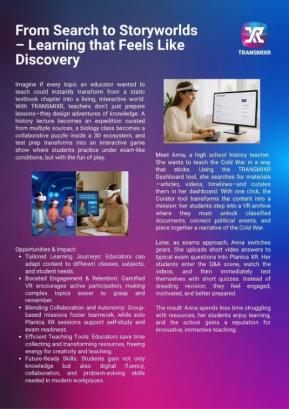
These ideal scenarios were then distilled into a set of inspirational creative concepts (see image 1), which represent big-picture ideas that illustrate how the TRANSMIXR technologies could be used beyond their original context and serve as starting points for future innovation and collaboration. For example, educators envisioned that the Newsroom Toolbox – initially aimed to help journalists identify breaking news or trending news by aggregating thousands of news sources, providing quick analysis and visualization options – could be used by teachers to aggregate information on specific topics to help them prepare their classes, such as in a history class.
Without the direct involvement and input from external stakeholders, it can be difficult to assess how a technology or product align with real-world workflows and practices or to identify what aspects of a technology or product may best fit within their context or practices.
Image 1: Final creative concept of immersive learning
Source: TRANSMIXR
3. From insights to policy action
The findings presented in this policy brief show that transferability is not something that emerges by chance, rather it requires time, structure, and deliberate choices throughout an innovation project’s lifecycle. The transferability workshop conducted within the TRANSMIXR project together with educators, illustrates that actively involving stakeholders through participatory reflection and co-creation increases the likelihood that technologies remain relevant and usable beyond their original context.
There are various benefits of reflecting on the transferability of technologies and products, which also shows a clear need for policy-level support. To make transferability a consistent outcome of innovation projects instead of an exception, it must become a part of project workflows, supported through cross-sector collaboration, and it must be underpinned by knowledge-sharing and capacity building. These practical lessons are reflected in the following policy recommendations, that translate insights into concrete action points that can contribute to the strengthening of long-term impact and sustainability of innovation projects.
| Embed transferability exploration in project workflows Make reflection on transferability an integral component of innovation projects by formally incorporating transferability-related tasks into work packages focused on exploitation, capacity building, or participatory evaluation. This ensures that transferability is addressed proactively rather than retrospectively. |
| Strengthen cross-sector collaboration and knowledge exchange Innovation programmes should actively encourage the involvement of stakeholders from potential transfer sectors from an early stage onwards. Cross-sector engagement should be recognized as a value-creating activity that improves relevance, inclusivity, and long-term adoption, rather than as an additional dissemination effort. Policy measures should support opportunities for interaction between sectors, such as joint workshops, communities of practice, capacity building sessions, and shared platforms for knowledge exchange. |
| Invest in capacity building for participatory methods Enable project teams to effectively explore transferability by supporting training, tools, and practical guidelines on the use of participatory and co-creation methods. Building this capacity helps translate technological potential into actionable insights that align with real-world needs across sectors. |
DOWNLOAD THE POLICY BRIEF
AUTHORS
Louise Hallström is a user researcher at Imec-SMIT, Vrije Universiteit Brussel and specializes in projects centered around personalized and immersive media experiences, as well as XR and AI-driven experiences. She applies co-creation methods, living lab methodology, and human-centered design to inform impactful and user-driven innovation. Louise.hallstrom@vub.be
Arno Verhofstadt is a user researcher at imec-SMIT, Vrije Universiteit Brussel where he executes user-research within EU Horizon 2020 projects related to immersive and personalized media such as XR and AI.
Arno.verhofstadt@vub.be
Iris Jennes is a user researcher at Imec-SMIT, Vrije Universiteit Brussel where she is involved in media innovation projects with a clear focus on immersive and personalized experiences. She applies qualitative research methods such as co-creation, living lab methodology, and human-centered design to ensure that media experiences resonate with diverse audiences.
Iris.jennes@vub.be
Wendy Van den Broeck is associate Professor at VUB and the head of the MUX research unit at Imec-SMIT, Vrije Universiteit Brussel. She is an expert in research methodology, personalized and immersive media, and smart education. She specializes in user research, using approaches and methods such as domestication research, living lab methodology, qualitative research methods, market research, and Quality of Experience research.
Wendy.van.den.broeck@vub.be
The MUX unit specializes in personalized and immersive media, retail and consumer services marketing, transformative consumer and service research, persuasive communication, user-centered design methodologies, living labs, and social marketing.
This policy brief is based on insights from the transferability activities conducted in the TRANSMIXR project. This project has received funding from the Horizon Europe programme under the Grant Agreement 101070109. To read more about the project, see: transmixr.eu .


