
20 January 2026
Mirte Brouwers, Dorottya Varga & Ruben D'Hauwers
Smart mobility is rapidly reshaping urban transportation in Belgium, but public authorities often lack clear governance frameworks to steer these innovations toward long-term societal goals. Drawing on the OptiRoutS project, this policy brief presents insights from extensive stakeholder engagement across Belgium, including in-depth interviews and a structured co-creation process. These activities made explicit the priorities that currently shape smart mobility decision-making and reveal where tensions and trade-offs emerge. While safety clearly emerges as the dominant priority across stakeholder groups, the findings expose a critical governance gap. Short-term objectives such as efficiency and congestion reduction are frequently prioritised over long-term societal objectives including sustainability and broader well-being. This brief responds to that gap by proposing a structured approach for translating stakeholder priorities into public governance values that can guide smart mobility decisions.
The policy brief provides policymakers and mobility stakeholders with a practical framework for embedding public value considerations into smart mobility governance. It offers a basis for prioritizing investments, evaluating solutions, and designing governance structures that remain resilient in the face of rapid technological change.
Highlights
| Safety is the non-negotiable governance priority Across all stakeholder groups, safety clearly ranks first. It is widely seen as the prerequisite for legitimacy and public acceptance of smart mobility initiatives. |
| Short-term priorities risk overshadowing long-term mobility goals Current smart mobility decision-making processes are better equipped to address short-term efficiency than to consistently embed long-term objectives such as sustainability and social inclusion. |
| Multi-stakeholder complexity undermines smart mobility governance Fragmented data systems, unclear communication channels, weak knowledge exchange, and diverging value priorities hinder coordinated mobility governance, reinforcing the need for inclusive, transparent decision-making structures. |
| Stakeholder priorities can be translated into actionable governance values The study demonstrates how stakeholder priorities can be systematically translated into governance values and integrated into an expanded public value framework to support policy design and evaluation. |
1. Why public values matter in smart mobility governance
Smart mobility fundamentally challenges existing governance arrangements. While new technologies promise efficiency gains and improved system performance, they also introduce new actors, decision logics, and dependencies that current policy frameworks are not designed to manage. Without clear steering mechanisms, decision-making risks become fragmented, reactive, and driven by short-term operational concerns.
In Belgium, smart mobility governance spans multiple policy domains, levels of government, and public–private partnerships. In the absence of a shared framework for prioritising societal objectives, coordination remains weak, and policy choices are often made in isolation. This limits the ability of public authorities to steer innovation towards long-term public outcomes.
Public values provide a practical governance anchor in this context. They clarify what mobility policy is expected to deliver beyond technical performance and market efficiency, and they offer a basis for prioritisation when objectives conflict. When such values are explicit, policy decisions are easier to justify, more consistent across actors, and more resilient over time.
Public authorities increasingly face difficult trade-offs between short-term and long-term objectives. Measures aimed at improving traffic flow or safety may conflict with sustainability, equity, spatial quality, or social inclusion. Without explicit guidance on how to balance these objectives, decisions become harder to defend and more vulnerable to contestation, increasing. uncertainty for public authorities, mobility providers, and citizens.
The absence of explicit value priorities creates risks. Smart mobility technologies directly shape access to public space and mobility opportunities. If value choices remain implicit, efficiency or commercial considerations may dominate by default, undermining public trust and democratic accountability.
A value-based governance approach helps to address these challenges. Stakeholder interviews conducted for this study show clear differences in priorities across actor groups, ranging from efficiency and innovation to accessibility, safety, spatial planning, and sustainability. Making public values explicit provides a shared reference point for navigating these differences, anticipating trade-offs, and aligning innovation with public goals.
The next section examines which public values stakeholders in Belgium currently prioritise and where the most critical tensions in smart mobility governance arise.
2. What stakeholders value and where tensions arise
2.1. Shared priorities across stakeholders
Across the interviews, stakeholders consistently pointed to a limited set of priorities that they consider fundamental for smart mobility decision-making:
- Safety
- Quality of life, including congestion, noise, and accessibility
- Sustainability & climate impacts
- Road classification, particularly emphasized by public authorities
Among these, safety clearly emerges as the dominant and non-negotiable priority. Stakeholders across all groups described safety as a prerequisite for public acceptance and political legitimacy. For policymakers, this convergence provides a clear signal: safety functions as a baseline against which smart mobility interventions are judged.
Beyond safety, stakeholders broadly agree that smart mobility should contribute to improved quality of life and reduced environmental impacts. While these priorities are articulated differently across actor groups, their repeated emphasis reflects a shared expectation that mobility policy should deliver benefits that extend beyond traffic efficiency, including more livable urban environments and better everyday mobility experiences.
These shared priorities have important governance implications. They create common ground for coordination across policy domains and actor groups, reduce the risk of contested decisions, and strengthen the legitimacy of public intervention. At the same time, convergence on priorities does not eliminate the need for choices. As the next section shows, tensions arise when stakeholders are required to prioritize among these objectives, particularly when short-term operational demands conflict with longer-term societal ambitions.
2.2. Diverging priorities and short-term versus long-term trade-offs
While stakeholders broadly agree on key priorities, significant tensions emerge when these priorities must be translated to concrete decisions. These tensions help explain why long-term societal objectives often struggle to gain traction in practice.
A central issue concerns the imbalance between short-term operational priorities and long-term objectives. Safety and traffic management are consistently treated as immediate and urgent concerns, while sustainability and broader well-being are often framed as longer-term outcomes. Although sustainability is frequently mentioned in interviews, it is less prominent when stakeholders discuss trade-offs. Several participants implicitly assumed that sustainability would follow automatically once safety and spatial order are addressed. This assumption risks weakening deliberate action on long-term climate and environmental goals.
A second source of tension relates to the differences in perceived responsibility and control. Public authorities emphasize instruments such as road classification and spatial planning as essential for steering mobility outcomes. Industry actors tend to focus on efficiency, innovation, and system performance. Civil society actors place greater emphasis on accessibility, inclusiveness, and everyday lived experience. These differing perspectives complicate coordination, particularly in public–private partnerships.
These tensions are further reinforced by fragmented governance structures and data ecosystems. Stakeholders point to inconsistent data standards, limited data sharing, and unclear decision-making authority as barriers to coordinated action. In this context, efficiency-driven or commercially attractive solutions are more likely to prevail, even when they do not fully align with broader societal objectives.
Finally, these diverging priorities raise a legitimacy challenge. While safety benefits from a clear and widely accepted mandate, other priorities lack equally strong operational safeguards. When they are not explicitly anchored in governance frameworks, public authorities may struggle to justify decisions, manage stakeholder expectations, and maintain trust over time.
Taken together, these findings suggest that the key governance challenge in smart mobility is not the lack of shared priorities, but the absence of clear mechanisms to manage trade-offs between them. Making these trade-offs explicit is a necessary step toward more coherent, legitimate, and resilient smart mobility governance.
3. From stakeholder inputs to public values in governance
Stakeholders typically describe what matters in smart mobility using practical, and operational terms such as safety, sustainability, congestion, and road classification. While these inputs are highly relevant for operational decision-making, they do not, on their own, provide clear guidance for governance. To support consistent and transparent policy choices, these priorities must be translated into public governance values that can steer strategy, regulation, and evaluation across mobility initiatives.
Public values provide a shared reference point for decision-making. They clarify objectives, support prioritisation when trade-offs arise, and define boundaries for public–private collaboration. This translation is essential because commonly cited drivers, such as efficiency, spatial order, or data interoperability, reflect underlying societal expectations rather than neutral technical considerations.
Based on the stakeholder-prioritised inputs identified in this study, four core governance values emerge:
- Safety
A non-negotiable baseline for smart mobility governance. Safety establishes the minimum standard against which all interventions should be assessed. - Sustainability
The long-term public interest is in reducing environmental impacts and ensuring that mobility systems remain viable within urban and planetary limits. Sustainability requires explicit policy choices and safeguards. - Personal and societal well-being
Derived from concerns about congestion, noise, accessibility, and health. This value emphasises improved everyday mobility experience and broader societal outcomes such as inclusive access and liveable public spaces. - Trust in Authority
Linked to road classification and spatial planning. Clear criteria, transparency, and consistency are essential for maintaining legitimacy, acceptance, and compliance.
Together, these governance values form a concise and actionable framework. They translate stakeholder priorities into decision-relevant guidance and provide a stable basis for assessing smart mobility interventions beyond short-term performance considerations. The next section shows how this value framework can be used to strengthen smart mobility governance in practice.
4. How public value prioritization can strengthen mobility governance
The stakeholder findings show that the main challenge in smart mobility governance is not a lack of shared values, but the absence of clear mechanisms to translate these values into consistent policy choices.
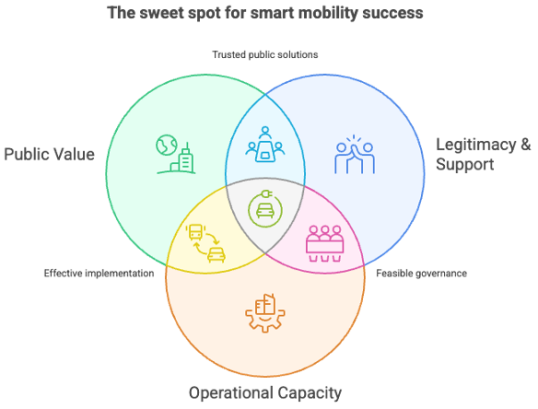
In practice, smart mobility interventions succeed when three conditions are met simultaneously. First, they must demonstrably contribute to public value. Second, they must command legitimacy, meaning that stakeholders and citizens understand and accept the decisions being made. Third, public authorities must have sufficient operational capacity to implement, monitor, and adapt interventions over time. This three-part logic, widely used in public management, provides a practical lens for assessing governance risks in smart mobility initiatives.
Applying this logic shifts governance away from isolated performance indicators toward integrated decision-making. Public value prioritization clarifies which outcomes should be protected, while legitimacy and operational capacity determine whether these outcomes can realistically be achieved. For example, a data-driven routing system may improve traffic flow, but without transparent decision rules and accountability, it risks undermining trust. Similarly, sustainability ambitions remain symbolic if public authorities lack the capacity to enforce standards or coordinate across policy domains.
By embedding public value prioritisation into governance processes, policymakers can make trade-offs more explicit and defensible. It supports more consistent investment decisions, clearer conditions for public–private collaboration, and greater resilience in the face of rapid technological change.
The next section translates this governance approach into concrete recommendations for policymakers and mobility stakeholders.
Image 1: Smart mobility governance
5. Recommendations
Building on the stakeholder-prioritised public values identified in this study, the following recommendations translate the findings into concrete governance actions. They are intended to support policymakers in steering smart mobility towards public value.
Embed value prioritization into mobility policy frameworks New technologies, pilots, and mobility projects should be systematically assessed against a clearly defined set of core public values. Integrating value-based impact assessments into policy processes can improve consistency, transparency, and accountability in decision-making. |
Strengthen structured multi-stakeholder collaboration Permanent governance platforms should be established to enable dialogue between public authorities, mobility providers, civil society, and research organizations. Such platforms can reduce fragmentation, improve coordination across policy domains, and support more coherent decision-making. |
Balance short-term and long-term public value outcomes While safety remains a primary concern, governance frameworks should avoid marginalizing longer-term goals such as sustainability and well-being. Mobility planning should incorporate long-term value metrics and scenario analysis to support balanced policy choices. |
Increase transparency around road hierarchy and routing decisions Clear and accessible communication about road classification and routing logic can strengthen trust in public authorities. Explaining how decisions relate to safety, sustainability, and spatial planning helps citizens better understand and accept governance choices. |
DOWNLOAD THE POLICY BRIEF
About the authors
Mirte Brouwers is a researcher in data, governance and communities at imec-SMIT, VUB. Mirte.brouwers@vub.be
Dorottya Varga is a senior researcher in data, governance and communities at imec-SMIT, VUB. Dorottya.Varga@vub.be
Ruben D’Hauwers is a doctoral researcher in data, governance and communities at imec-SMIT, VUB. Ruben.DHauwers@vub.be
Data, Governance and Communities Unit – Unit Lead: Karl-Filip Coenegrachts, Karl-Filip.Coenegrachts@vub.be
This policy brief summarizes findings from the study Prioritizing values in smart mobility governance: A stakeholder-based analysis (Brouwers, Varga and D’Hauwers). https://doi.org/10.1016/j.jum.2025.03.003


