
June 2026
Pauljan Truyens, Sarah Vis, Sien Van de Wouwer & Ike Picone
Today, the Reuters Institute for the Study of Journalism publishes its annual Digital News Report, for which imec-SMIT-VUB is the Belgian partner. The report features a Country Page for Belgium with use and trust data for the most important Belgian news brands.
This policy brief summarises the most important findings on Flemish news use in 9 important trends. We conclude by providing some lessons from 10 years of DNR in Flanders. All key trends are also available online in Dutch on www.nieuwsgebruik.be or you can download this policy brief in Dutch below.
Curious how these findings fit in with previous evolutions? Then be sure to take a look at our updated NEWS MONITOR.
Key Trends
9 key trends
| 1. Shifting news access, shrinking news use Over the past decade, Flemish news use has declined and shifted from print, television, and radio toward online sources, but something was lost in transit as news use declines overall. Social media became more central as a pathway to news, yet on the bright side direct access to news brands also grew. |
| 2. News interest continues to decline, particularly among youngsters News interest in Flanders remains relatively high but is steadily weakening. Strong engagement has dropped sharply since 2017, while news disinterest is now witnessed among almost one in five Flemish people. The decline occurs across all age groups but is most pronounced among younger Flemish people. |
| 3. Young people use ‘newsfluencers’ as a complementary news source Newsfluencers are not widely consulted as Flemish news users question their reliability and impartiality. Yet, they play a significant complementary role among younger news users: a large proportion gets news from influencers, valuing their entertaining style whilst remaining critical of its reliability. |
| 4. AI chatbots are used to process rather than access news While the use of AI chatbots is on the rise globally, uptake among Flemish news users remains limited. When Flemish people do use an AI chatbot for news, they use it in strikingly opposite ways: either to compress news stories into a summary, or to expand a story with additional information, but rarely to simply access it. |
| 5. News on social media keeps fuelling distrust Trust in news in Flanders has declined over the past decade, especially since the COVID-19 peak in 2021. Trust in the news one personally uses remains stable. Social media news inspires the most distrust, comparable only to AI chatbot news. Internationally, Flanders scores relatively high, while Wallonia scores much lower. |
| 6. News users think mainly politicians and experts influence the news Flemish news users perceive mainly politicians and experts as influencing news coverage. Political preference shapes these views: left-wing respondents emphasize owners, advertisers, and politicians, while right-wing respondents stress activists and interest groups. |
| 7. The quality of reporting is largely seen as neither good nor bad Most Flemish news usets are neither enthusiastic nor critical about how major news stories are covered. Where opinions do diverge, political preference is the clearest dividing line. Coverage of migration stands out: right-wing respondents judge it more negatively than respondents with other political views. |
| 8. Talking face-to-face remains most popular way of news engagement Face-to-face conversations remain the dominant and growing form of news participation in Flanders, while active participation through e.g., online comments remains limited. Online news sharing has declined, especially on public social media, in favour of sharing via private messaging. |
| 9. Most people feel lukewarm about news provided by PSM 42% of Flemish news users think public media have neither a positive nor a negative impact on life in their country. Of those who do have an opinion, the positive views centre on access to reliable and local news; the negative views concern political influence. |
1. Shifting news access, shrinking news use
The share of Flemish news users consulting news daily dropped from 89% in 2017 to 72% today, a decline of 17 percentage points. Beyond frequency, the mix of sources has also shifted significantly, with traditional outlets such as print, television, and radio losing structural ground.
Print shows the sharpest decline, falling from 47% to 21%, a loss of 26 percentage points, with most of this drop occurring after 2022. Newspapers are losing ground across all age groups. Television was once highly popular, with 73% of news users watching the evening news in 2017, a figure now down to 51%. The decline is especially pronounced among younger viewers, only about one in three of whom now watch TV news, compared to roughly 60% in 2017. Yet among those who still watch, television increasingly serves as their main news source, with one in three news users still naming it as such. Radio remains the most stable traditional source, down only 9 percentage points, with about one in three news users still listening to radio news.
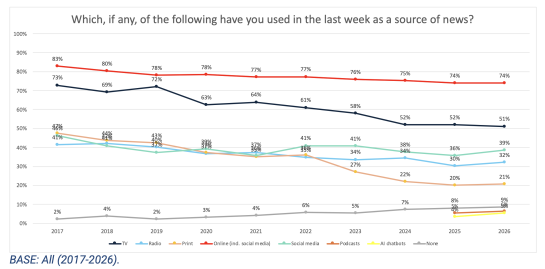
As news users move further into an online media landscape, does this mean they consult news more often? Logically, online media would be expected to take over the role of traditional media, yet full compensation has not materialised: although online media remain the most popular news source, their use has also declined, from 83% to 74%.
Despite the rise of algorithm-driven platforms, the share of Flemish people going directly to a news website or app increased from 32% to 44%. This suggests that direct engagement with news brands themselves has risen, led mainly by VRT NWS, which sees 40% of Flemish news users access news from the brand via online channels in the last week, up from from 33%. HLN remains the most consulted brand overall (45% used it over the last week), despite a slight decline.
Social media as a news source stayed relatively stable, but its role as a primary source nearly doubled to 16% of Flemish news users now mentioning it as their main source of news, and mounting to 37% amongst those aged 35 and under. The gap between using social media for news and relying on it as the main source is narrowing. Within social media, Instagram shows the strongest growth as a news source, while Facebook, YouTube and LinkedIn remain fairly stable. AI chatbots have also emerged as a news source in the past two years, though their share remains modest for now (5%).
With online news use declining overall, one might wonder whether today's online news user is simply less engaged with news. Part of the answer may lie in the growing share of Flemish people, nearly one in ten, who report not having consulted any news in the past week, a trend that aligns with the steady rise in news disinterest over the past decade (also see Keytrend 4).
2. News interest continues to decline, particularly among youngsters
How interested are Flemish people in news today? Ten years of Digital News Report data show a clear trend: news interest is steadily declining. While a large majority still say they are at least somewhat interested in news, it is strong interest and engagement that is eroding year after year.
The sharpest drop is among those who say they are very or extremely interested in news, from 62% in 2017 to 36% in 2026. The COVID-19-period brought a temporary revival, with strong interest rising again to 59% in 2021, but this was short-lived: from 2022 onwards, the decline resumed, even more steeply. At the same time, the share of Flemish people saying they are not interested in news at all has grown, from 4% in 2017 to 18% in 2026 (+14pp).
Despite these trends, overall news interest remains relatively high: 83% of Flemish people say they are at least somewhat interested in news, down from 96% in 2017. This points not so much to a general aversion to news, but rather to a marked decline within specific segments of the population.
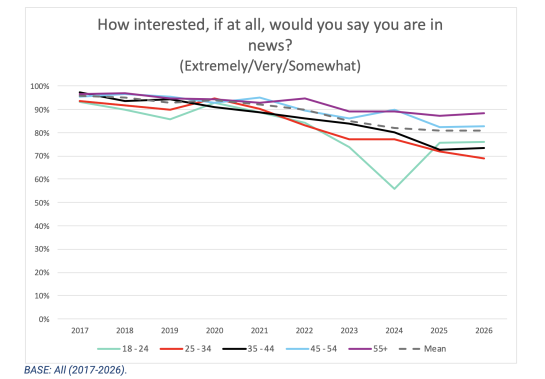
Although news interest is clearly linked to age, the decline is not limited to one group: interest has dropped across all age groups, just not equally. The shifts are largest among Flemish people under 45, widening the gap between young and old. Among 25- to 34-year-olds, the share who are at least somewhat interested fell by 25 percentage points to 69% of Flemish news users in 2026, and among 18- to 24-year-olds (76%) by 17 percentage points, compared to 13 percentage points among 45- to 55-year-olds (83%) and 9 percentage points among those 55 and older (81%).
Overall, news interest in Flanders has not simply evaporated, but it has changed substantially. While most Flemish people still describe themselves as interested in news, strong engagement is fading, while the group with no interest at all keeps growing, a shift most visible among younger age groups. The challenge, then, is not just reaching people, but keeping them engaged over the long term.
3. Young people use ‘newsfluencers’ as a complementary news source
Social media have become a fixed part of daily news use among Flemish people, especially younger ones. At the same time, influencers and content creators increasingly engage with news themselves, some focusing explicitly on news and societal topics, others combining it with lifestyle, entertainment or personal content. For most Flemish people, however, the role of these so-called "newsfluencers" remains limited. Three quarters of Flemish people (75%) say they do not follow news via influencers, while only small groups follow influencers who focus specifically on news (8%) or influencers who mainly create other content but occasionally touch on current affairs (10%).
This reluctance is linked to how this content is perceived compared to traditional news media. Almost half (46%) consider influencer news less reliable than that of established news brands, 40% find it less impartial, and a third see it mainly as entertainment.
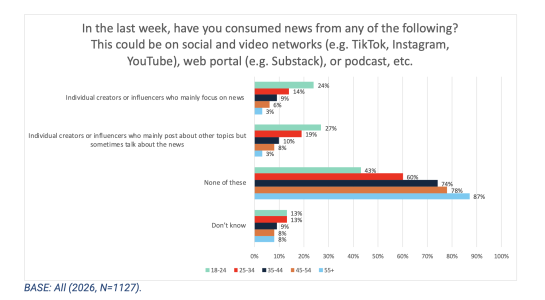
Behind these overall figures lie clear age differences. In 2017, 23% of young Flemish people (18-24) named social media as their main news source; by 2026, this has risen to 43%. While traditional news brands also continue to build their presence on social media, they share this space with influencers. Almost a quarter of young people (24%) follow influencers focused on news, and another 27% follow influencers mainly covering other topics who also touch on news. Though this does not mean these influencers are replacing traditional media, rather, they play a complementary role in young people's news repertoire.
This does not mean Flemish young people trust this content unconditionally. They remain critical: 45% consider influencer news content less reliable than traditional news channels, while just over a quarter (27%) consider it equally reliable. What young people appreciate most is how newsfluencers present information. More than half (56%) find their news content more entertaining than that of traditional media, and 46% find news via influencers easier to understand. These influencers thus seem to succeed in making news more accessible and approachable for young people, even if they are not necessarily seen as equally reliable. This deserves attention as we know that news users are often willing to prioritise ease of use over reliability.
4. AI chatbots are used to process rather than access news
AI chatbots have emerged as a news source over the past two years, though their share remains modest. Use as a news source increased by one percentage point, from 4% in 2025 to 5% in 2026, mainly via ChatGPT and Google Gemini; indicating we see little further uptake for now.
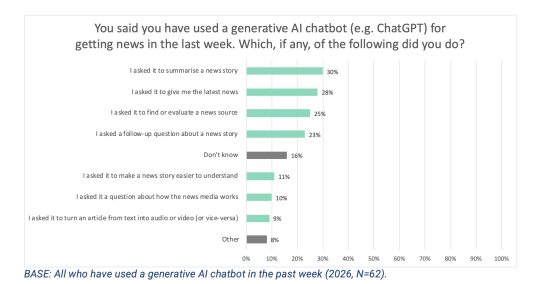
Within this small group (N=62), the main reasons for using AI chatbots are to dig deeper into a story through follow-up questions, because chatbots make complex news stories more digestible, and because tools like ChatGPT bring together different news sources into a single response. Other reasons mentioned are that chatbots "always have an answer ready" and that they are faster than other news sources.
In practice, this mainly translates into asking the chatbot to summarise the news, to give a quick overview of the latest news, or to evaluate a source. For some, AI chatbots also act as a gateway to other news sources. They click through on the sources a chatbot suggests getting more detail, to verify whether the chatbot's information is accurate, or to check whether the cited source actually exists.
5. News on social media keeps fuelling distrust
Every year we report on trust in news. 2026 offers a chance to look back over a ten-year period. In 2017, around 57% of Flemish people said they generally trusted the news, compared to just under half today. This 7-point decline tells only part of the story: trust fluctuated considerably between 2017 and 2021, with the first COVID year marking a turning point, when 61% reported trusting the news, the highest level in the 2017-2026 period. Since then, trust has declined steadily, with a particularly sharp drop in 2023. Trust in the news people consume themselves remains notably higher (58%) and stable through the last ten years.
The DNR also probes trust in news accessed via social media and via search engines. For the latter, we see a clear 10 percentage points difference from 37% in 2018 to 27% in 2026. Trust in news on social media was already low in 2018 (23%) and has fallen further to just 11% in 2026. Notably, half of Flemish news users explicitly express distrust in news via social media. Only trust in news via AI chatbots, now measured for the first time, shows a similarly skewed pattern (11% trust versus 53% distrust), although this is based only on a small share of respondents (5%).
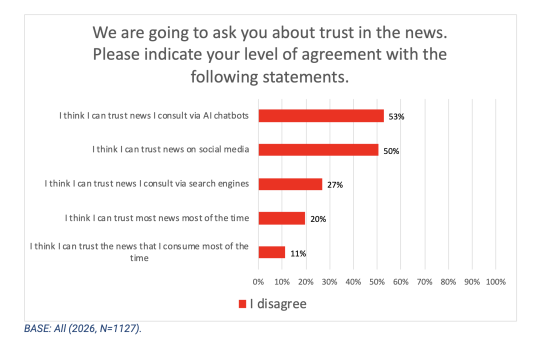
To put these figures in perspective, we look across the language border and at neighbouring countries. In Wallonia, general trust in news is markedly lower, at 28% this year. As a weighted average of Flanders and Wallonia, overall trust in Belgium is relatively low (39%).
Internationally, Belgium falls in the broad middle ground. Within this group, mostly consisting of other Western European countries, Flanders ranks among the higher trust levels, while Wallonia sits near the bottom. Among our neighbours, trust in news is relatively high in the Netherlands (49%), while Germany tracks closely with Belgium (46%). In France, trust stands at around one in three news users (29%, mirroring the figures seen in Wallonia. The global average is 37% (covering nearly 50 countries across five continents).
6. News users think mainly politicians and experts influence the news
How objective or impartial Flemish people consider the news to be is one of the factors that influences trust. In principle, journalists operate independently from external influence and rely on editorial independence to limit possible internal or external influences.
Flemish news users, however, perceives this differently. As many as 70% believe that politicians and government officials have some influence on the reporting of Flemish news media. An almost equally large group, 68%, considers experts such as academics, researchers, and scientists to be influential. Internal actors, more specifically the owner of the news outlet or the parent company, are also seen as influencing coverage by 65% of Flemish people. More than half, 55%, see advertisers as a sphere of influence. Activists and interest groups are also considered influential by around 50% of Flemish people. This does not necesarily mean that news users do not trust the news; it could also be a sign of news literacy and a nuanced view on the many actors in society that could affect news coverage.
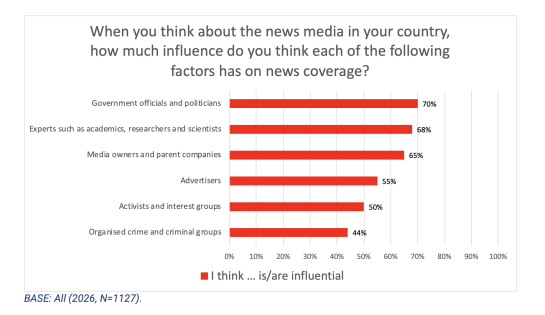
Political preference, often a distinguishing factor in news attitudes, is an interesting lens through which to examine these spheres of influence. Flemish people with a left-wing political preference believe that the owner of the news outlet has the greatest influence. They also think that advertisers and politicians influence news coverage, in each case clearly more so than Flemish people with a right-wing political preference. Conversely, more Flemish people with a right-wing political preference believe that activists and interest groups influence news coverage.
The largest differences, however, emerge between Flemish people with and without a political preference. The latter more often indicate “Don’t know.” This is in line with the relationship between interest in politics and interest in news. The greater someone’s interest, the more likely they are to take a position. This thus also applies to possible spheres of influence in the reporting of Flemish news media.
7. The quality of reporting is largely seen as neither good nor bad
In addition to reporting on current affairs, much news coverage revolves around following major news stories such as wars, geopolitical shifts, political developments, and climate change. So how do Flemish people think our news media cover these major news stories? In short: neither good nor bad.
What stands out is that most Flemish people, often around 40%, judge the quality of news media coverage of major news stories as neither good nor bad. A solid 10% even indicate “Don’t know.” For most major news stories, the share of people who think news media are doing a good job and the share who think they are doing a bad job are roughly balanced. News coverage of climate change, inflation and the cost of living, Trump’s presidency, and the conflict in the Middle East is rated as good by between 20% and 30% of Flemish people, with a roughly equal share rating it as bad.
The largest differences are found in coverage of the war in Ukraine and immigration/migration. For the former, clearly more Flemish people think news media are doing a good job, 30%, than a bad job, 19%. For immigration/migration, the opposite is true: 17% good versus 31% bad.

Political preference is the most striking lens to look at the perceived quality of reporting. The largest differences emerge in news coverage of immigration/migration. Among Flemish news users with a right-wing political preference, 54% think news media do a bad job when reporting on this topic, compared with 31% among Flemish people with a left-wing political preference. A clear gap between left and right is also visible in news coverage of Trump’s presidency. Respectively, 27% and 39% think news media do a bad job in their reporting of the president. A recurring pattern is that Flemish people who do not express a political preference are also more likely to select “Neither good nor bad” or “Don’t know.”
8. Talking face-to-face remains most popular way of news engagement
Over the past ten years, the way Flemish people engage with news has changed, but one form of participation stands out for staying strong: face-to-face conversation remains the most popular way to participate in news, even in a digital media world. Not only has it remained the most popular form of news participation, but it is also one of the few to have grown over the past decade, from 25% in 2017 to 34% in 2026, a rise of 9 percentage points. Sharing news online shows the opposite trend, with the share of Flemish people sharing news falling from 23% to 15% over the same period. One possible explanation could be that news users seek out interpretation, validation or verification for the news they encounter amongst friends, family and colleagues, as additional qualitative research from our team showed that discussing the news with other is also a strategy to cope with doubt about the reliability of a news story.
Within this decline, a clear shift is visible. Sharing news via social media such as Facebook and X continued to decrease, from 13% in 2017 to 5% in 2026, while sharing via instant messengers such as WhatsApp increased, from 6% to 10%. Flemish news users who share news online are thus doing so less in public and more within private, interpersonal circles. Here too, various experts suggest that the vitriolic nature of much online debate and the fear of being targeted with hate speech has led people to chose for the safety of closed groups or communities.
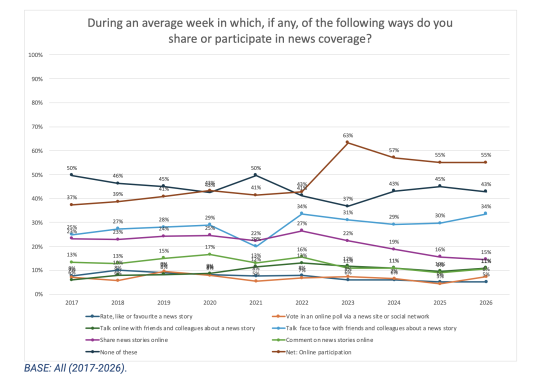
The largest group remains those who do not participate at all. Almost half of Flemish people, 43% in 2026, neither share nor talk about news, down from 50% in 2017. More visible, active forms of online participation follow the same trend. The share of Flemish people commenting on news stories, for instance, also remained low at 11% now. Despite the ubiquity of social media, Flemish news users thus remain reluctant to participate in online news discussions.
9. Most people are lukewarm towards PSM’s effect on life
Public service media (PSM), and in first instance VRT, remain widely used and trusted in Flanders. Still, 42% say that PSM have neither a positive nor a negative effect on life in their country, while 31% rate their impact as positive and 17% as negative. Among those who view PSM positively, this is mainly linked to its core public tasks: more than half specifically appreciate the public broadcaster for offering access to key national and regional news and for its reliable news. Appreciation thus stems primarily from the accuracy, relevance and accessibility of news provided by PSM.
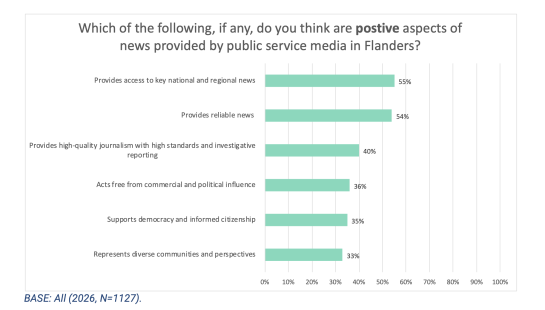
Amongst the 17% of Flemish news users that see PSM’s effect on life in Flanders as negative, not so much the fact that news from PSM is unreliable, but rather that news from PSM is influenced by political interests and focuses too heavily on certain topics and groups seems to be the main concern.
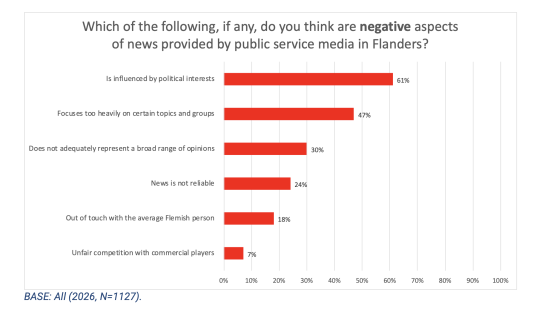
Overall, attitudes toward PSM are lukewarm. In Flanders, VRT is a household name. As a brand, it is widely used and trusted. A potential explanation of this attitude could be that news from PSM is mainly seen as a given, as a public service taken for granted rather than something one has strong opinions about.
Conversation starter
| What lessons can be learned from ten years of DNR Flanders? |
Seeing the silver linings in the news media crisis This is also reflected in a decline in interest in news, with 18% of Flemish news users now stating they are not interested in the news compared to only 4% in 2017. And 66% of them say they avoid the news in some form up from 48% in 2017. The bottomline is that people have simply started consuming less news. Or to put it even more bluntly: in the battle for attention, news providers are not in the winning team. Yet, remarkably, where it becomes increasingly challenging for news media to grab people’s attention, they seem to be quite well in gaining or retaining their trust. Sure, trust in news in general has also decreased in the past decade, but the trust score of Flanders’ main news brands continues to be remarkably high, and this across public and private media (see the DNR Country Report for Belgium). So, trust in familiar news brands is holding up even as access moves to less trusted platforms. This is an important nuance to keep in mind when discussing the crisis of news media. When we talk about news media as caught in a structural squeeze, we should be precise: the squeeze is on attention, and subsequently referrals and revenue, not on the underlying relationship audiences have with brands they know. Sure, news (as the world it depicts) might be too much for a substantial number of people, but when they need news, many of them turn to these trusted brands. Hence, the issue of attention and of trust might be all too easily lumped together in a narrative of crisis, obscuring the silver linings for news media – certainly in Flanders, but also in many other markets covered in the Digital News Report. Taking a good look inward We can of course continue to frame the crisis in the news in terms of what is being done to journalism by AI, platforms and funders. In doing so, it would be shortsighted to exempt news media from any responsibility. By now, many studies have identified what keeps younger news users away from traditional news brands: formats too rigid for the fast, multi-tasking flow of their lives, limited affinity with their personal concerns or those of their communities, and a lack of transparency on editorial reporting motives. Journalists often take their (intended) audience for granted, as eyeballs that will always be there waiting for the news to be offered to them, but the data (e.g., on ‘newsfluencers’) are showing that news users happily get their information from plenty of other, more accessible sources. You can have all the support and regulation in the world, but tackling that challenge will need to come from journalists’ own creative minds. All things considered, on the eve of yet another life-changing technological revolution that is forcing the news media to change course, the Flemish news sector finds itself not in the worst of positions. The challenges are vast, certainly, but there is no reason for nism as this only serves the interests it condemns, to reference Rasmus Kleis Nielsen, one of the co-authors of the Digital News Report. If there is one thing that can help news media to face the next period, it is, hopefully, a more nuanced and timely understanding of the audiences news media seek to serve. |


